Product Details
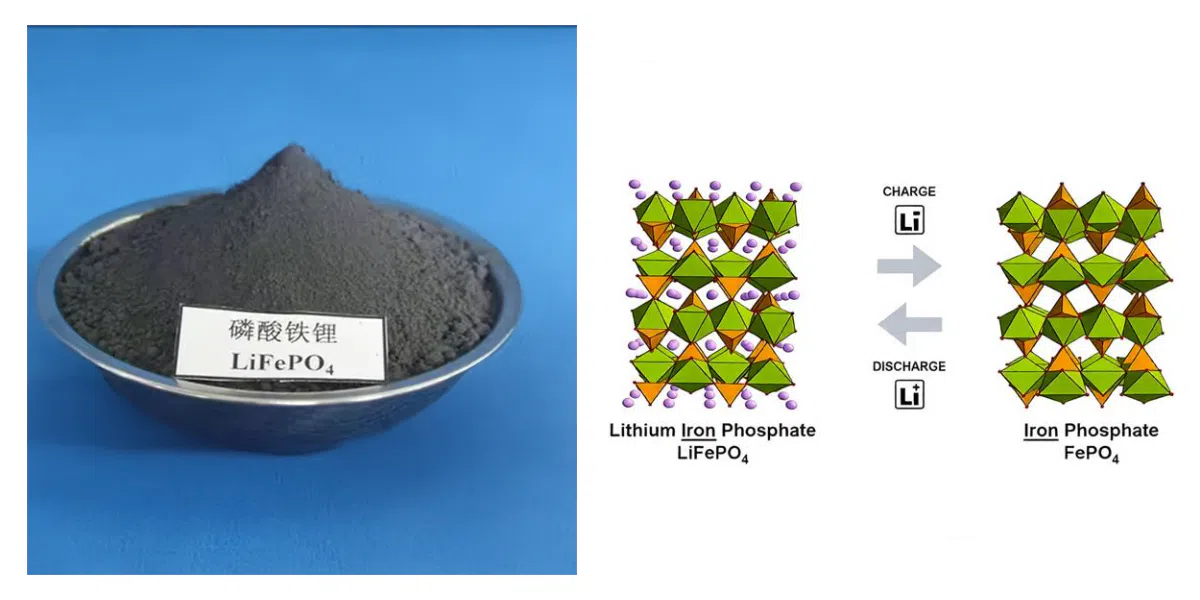
Lithium iron phosphate (LiFePO4), commonly abbreviated as LFP, is an inorganic compound used as the cathode active material of lithium-ion batteries. It crystallises in an olivine-type orthorhombic structure in which PO4 tetrahedra and FeO6 octahedra build a rigid three-dimensional framework that hosts lithium ions. The material was first shown to reversibly insert and extract lithium by J. B. Goodenough and co-workers at the University of Texas at Austin in 1997, and industrial production began in 2001 after carbon coating solved its intrinsically low electronic conductivity.
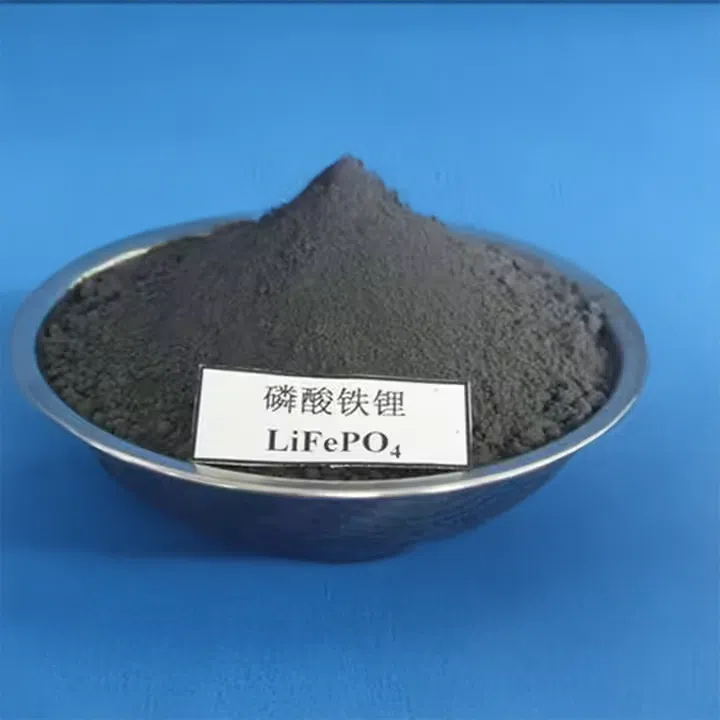
Commercial LFP is supplied as a carbon-coated, grey-black powder. Because the strong P–O bonds remain intact during charge and discharge, the material withstands overcharge, over-discharge, short circuit, crushing and nail penetration without combustion, and its thermal runaway onset is far higher than that of nickel-cobalt chemistries. Together with a long cycle life, a flat 3.2–3.4 V discharge plateau and the complete absence of cobalt and nickel, these properties make LFP the dominant cathode chemistry for electric vehicles and stationary energy storage.
Chemical Composition (mass fraction, %)
| Component | Battery Grade |
| Li | 4.00 – 5.00 |
| Fe | 33.00 – 36.00 |
| P | 18.00 – 20.50 |
| C (carbon coating) | 1.00 – 4.00 |
| / Cu / Al | / ≤0.030 / ≤0.050 |
| / Na+K / Cr | / ≤0.010 / ≤0.060 |
| / F | / ≤0.010 |
| Moisture | ≤0.10 |
| Magnetic impurities | ≤0.0003 |
| pH value | 7.0 – 11.0 |
Product Applications
LFP is the active component of the positive electrode in lithium-ion cells. It is coated onto aluminium foil together with a conductive agent and a binder to form the electrode, and is paired with a graphite anode, a separator and an organic electrolyte to build the cell.
Electric-vehicle traction batteries — mainstream cathode for passenger cars, buses and commercial vehicles, notably in blade-cell and CTP pack designs.
Stationary energy storage — grid-side peak shaving, wind and PV co-location, commercial and industrial ESS and residential storage, where long life and safety are decisive.
Telecom base-station and UPS backup power — 48 V DC systems replacing lead-acid batteries.
Low-voltage and start-stop batteries — 12 V / 24 V / 48 V vehicle systems substituting lead-acid.
Electric two-wheelers, power tools and light electric vehicles — small-power applications requiring high safety and long life.
Marine and special-purpose power — electrified vessels and equipment operating in demanding environments.
Recycling and regeneration — end-of-life LFP powder is recovered and re-sintered into regenerated cathode material.