Product Description of Diethyl Carbonate CAS#105-58-8
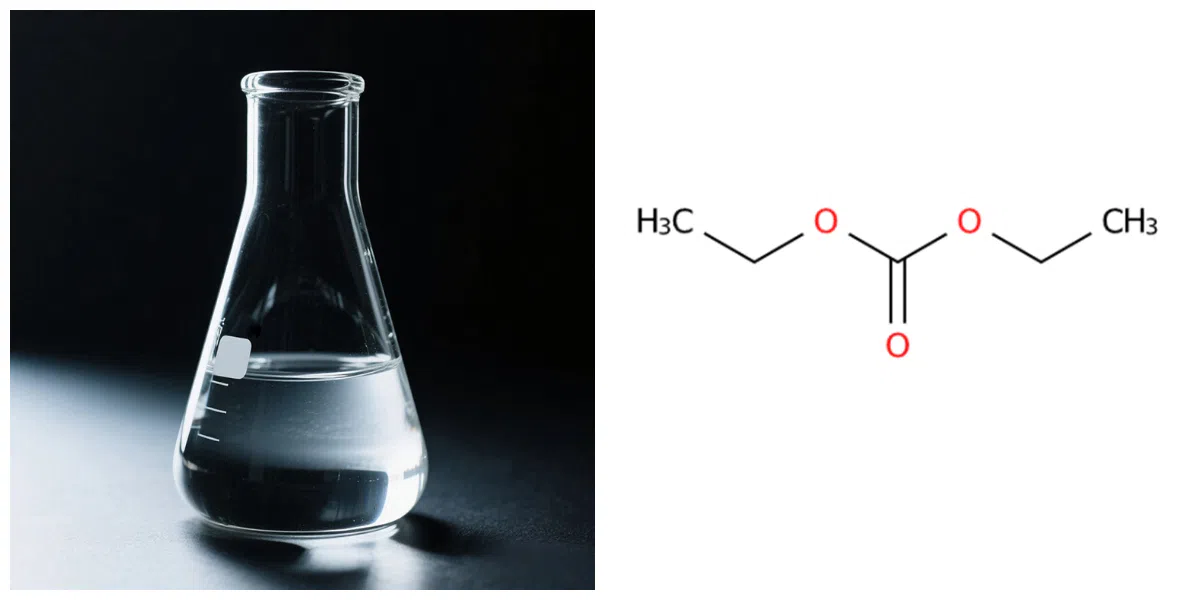
Diethyl carbonate (DEC) is an organic compound bearing ethyl, ethoxy, carbonyl, and ethoxycarbonyl moieties, which endow it with significant chemical reactivity. It finds extensive use as a reagent in carbonylation, alkylation, and carbethoxylation processes.
DEC is a strongly hygroscopic, aprotic solvent with a favorable environmental profile. It is frequently employed in the processing and formulation of nitrocellulose, cellulose ethers, and a variety of resin systems.
Chemical Properties
| Melting point | -43 °C (lit.) |
| Boiling point | 126-128 °C (lit.) |
| density | 0.975 g/mL at 25 °C (lit.) |
| vapor density | 4.1 (vs air) |
| vapor pressure | 10 mm Hg ( 23.8 °C) |
| refractive index | n20/D 1.384(lit.) |
| Fp | 88 °F |
| storage temp. | no restrictions. |
| solubility | 18.8mg/l insoluble |
| form | Liquid |
| color | Clear |
| Odor | Pleasant, etheral; mild and nonresidual. |
| PH | 6.3 (1g/l, H2O) |
| explosive limit | 1.4-11.0%(V) |
| biological source | mouse |
| Water Solubility | Negligible |
| Sensitive | Moisture Sensitive |
| Merck | 143780 |
| BRN | 956591 |
| Henry's Law Constant | 1.0×10⁻¹ mol/(m3Pa) at 25℃, Burkholder et al. (2019) |
| Dielectric constant | 2.8(Ambient) |
| Stability: | Stable. Flammable. Incompatible with strong acids, strong bases, reducing agents, oxidizing agents. Protect from moisture. |
| InChI | 1S/C5H10O3/c1-3-7-5(6)8-4-2/h3-4H2,1-2H3 |
| InChIKey | OIFBSDVPJOWBCH-UHFFFAOYSA-N |
| SMILES | O=C(OCC)OCC |
| LogP | 1.21 at 25℃ |
| Surface tension | 29.2 mN/m at 273.18K |
| CAS DataBase Reference | 105-58-8(CAS DataBase Reference) |
| NIST Chemistry Reference | Carbonic acid, diethyl ester(105-58-8) |
| EPA Substance Registry System | Diethyl carbonate (105-58-8) |
Safety Information
| Hazard Codes | T,Xi |
| Risk Statements | 23/24/25-36/37/38-10 |
| Safety Statements | 26-36-45-16-23 |
| RIDADR | UN 2366 |
| WGK Germany | 3 |
| RTECS | YE1050000 |
| F | 21 |
| Autoignition Temperature | 445 °C |
| TSCA | TSCA listed |
| HS Code | 2920 90 10 |
| HazardClass | 3 |
| PackingGroup | III |
| Storage Class | 3 - Flammable liquids |
| Hazard Classifications | Flam. Liq. 3 |
| Hazardous Substances Data | 105-58-8(Hazardous Substances Data) |
| Toxicity | LD50 orally in Rabbit: > 4900 mg/kg |
| LC50 (inhalation) > 21 mg/kg (mouse) | |
| TDL0 500 mg/kg (mouse) | |
| LD50 (s.c.) 8500 mg/kg (rat) |
Product Application of Diethyl Carbonate CAS#105-58-8