Products Description of Dioctyl Sulfosuccinate Sodium Salt CAS#577-11-7
Docusate sodium is commonly used to ease constipation as both a laxative and a stool softener. It's also being used to make electrospun fibers that can deliver antibiotics in a controlled, customized way.
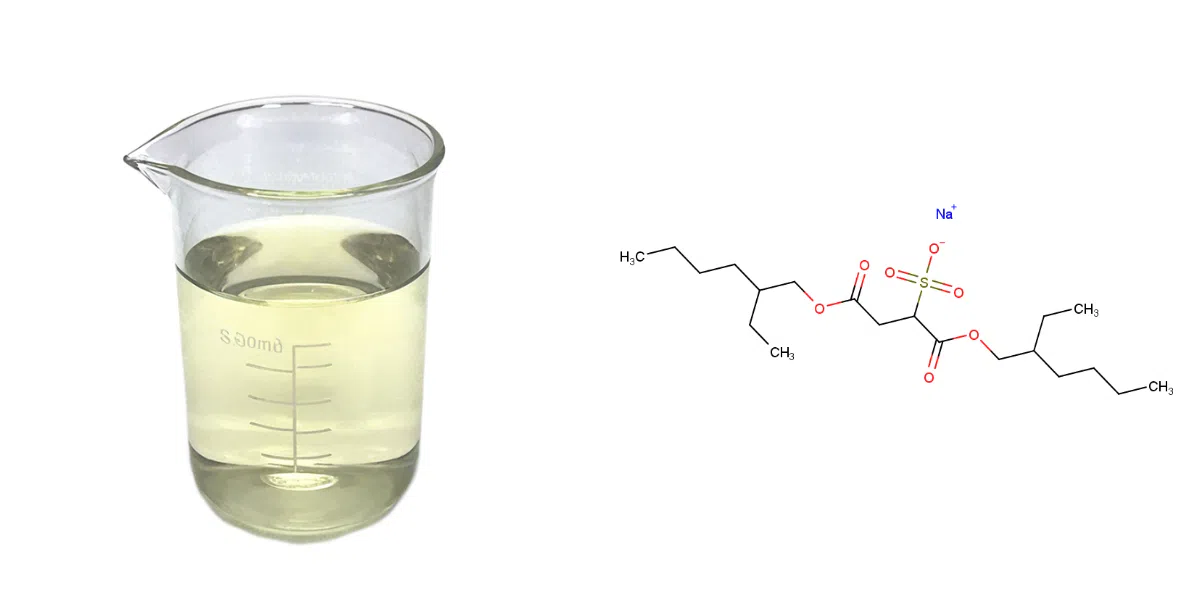
Dioctyl sulfosuccinate sodium salt Chemical Properties
| Melting point | 173-179 °C(lit.) |
| Boiling point | 82.7°C |
| Density | 1.1 |
| Vapor pressure | 0Pa at 25℃ |
| Storage temp. | Inert atmosphere,Room Temperature |
| Solubility | methanol: 0.1 M at 20 °C, clear, colorless |
| Form | Waxy Solid |
| Color | White |
| Specific Gravity | 1.005_PERCENT VOLATILE: 40 |
| Water Solubility | 1.5 g/100 mL (25 ºC) |
| Sensitive | Hygroscopic |
| λmax | λ: 260 nm Amax: 0.1 |
| λ: 280 nm Amax: 0.05 | |
| Merck | 143,401 |
| BRN | 4117588 |
| Stability | Stable. Combustible. Incompatible with strong oxidizing agents. |
| InChIKey | APSBXTVYXVQYAB-UHFFFAOYSA-M |
| LogP | 1.998 at 20℃ |
| CAS DataBase Reference | 577-11-7(CAS DataBase Reference) |
| EPA Substance Registry System | Bis(2-ethylhexyl) sodium sulfosuccinate (577-11-7) |
Safety Information
| Hazard Codes | Xn,Xi |
| Risk Statements | 22-38-41-36/37/38 |
| Safety Statements | 26-39-37/39-36 |
| WGK Germany | 2 |
| RTECS | WN0525000 |
| F | 3-10 |
| TSCA | Yes |
| HS Code | 29171900 |
| Hazardous Substances Data | 577-11-7(Hazardous Substances Data) |
| Toxicity | LD50 oral in rat: 1900mg/kg |
Product Application of Dioctyl Sulfosuccinate Sodium Salt CAS#577-11-7
Docusate sodium is commonly used to relieve constipation as a laxative and stool softener. It's also used to make electrospun fibers that can deliver antibiotics in a controlled, customized way. In the textile industry, it works as a versatile agent—acting as an emulsifier, detergent, penetrant, thickener, and wetting agent—with great permeability and wettability.
Also known as Aerosol OT, it serves as a lubricant and is widely used as a surfactant, emulsifier, and wetting agent in printing, dyeing, and cosmetics. Mixed with CAPSO, it can form microemulsion electrophoresis systems for detecting natural and synthetic estrogens. It's also used to prepare reversed-phase microparticles in hydrocarbon solvents and is good for dissolving most membrane proteins. Other uses include acting as a surfactant, penetrant, emulsifier, and leveling agent in printing and dyeing, and as an emulsion ingredient for photosensitive materials.